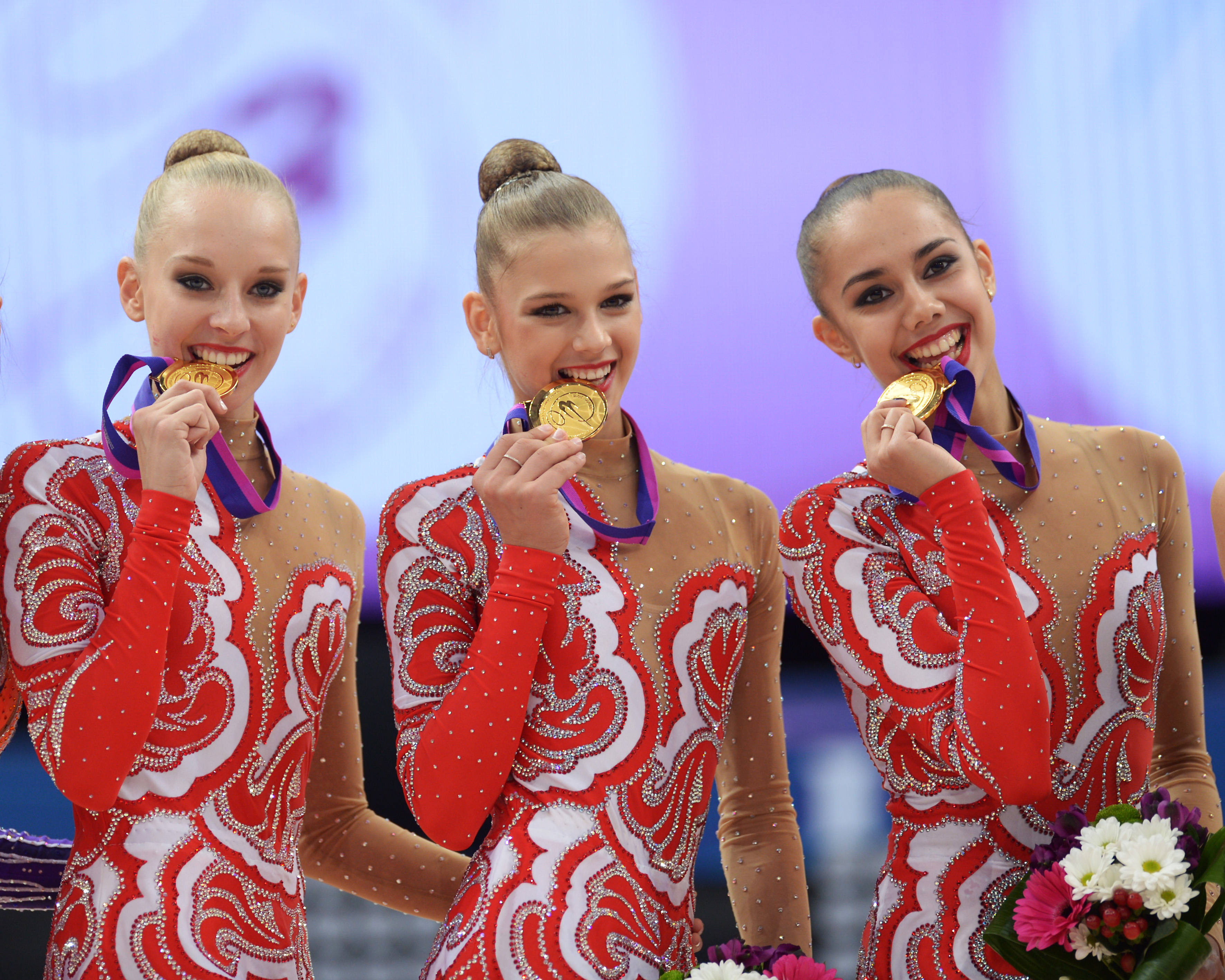
The World of Rhythmic Gymnastics is in full swing. The 34th World Championships in Stuttgart (GER), from 7 to 13 September 2015, determine the participants of the Rio 2016 Olympic Games. Gymnasts and choreographers are aware. The IOC allots 96 places to the discipline, 14 groups (70 gymnasts) and 26 individual athletes. That’s all!
Gymnastics close to its audience.
It’s the third Rhythmic Worlds organised by the DTB, the German Gymnastics Federation. The first took place in Munich in 1981, followed by Berlin in 1997. Noteworthy, it was during those last Championships, held in the Max Schmeling Halle, that the Longines Prize of Elegance was inaugurated. The name of Russia’s Natalya Lipkovskaya was the first on this prestigious list.
In Stuttgart, in total 285 women will dream of becoming an Olympian, or of a World title, as soon as they set foot onto the beige floor, of constructor Spieth, in the middle of the Porsche Arena. It’s a safe bet that the 5000 seats available for each session will be fully booked quickly by the spectators of Stuttgart and its region, where the passion for gymnastics is widely-known.
Talking statistics, we note that of the 58 participating federations, 37 are European, represented by 173 gymnasts, of which 98 individuals and 75 composing 15 groups.
Too much Europe?
In Munich in 1981, four of the five gold individual medals were won by the Bulgarians (Anelia Ralenkova, Lily Ignatova). In Berlin in 1997, Ukraine’s Olena Vitrychenko won fourof them, compared to only one each won by the Russian gymnasts Yana Batyrchina and Natalya Lipkovskaya.
In 2015, in Stuttgart, all eyes and all forecasts turn to the Russian camp and to Yana Kudryatseva and Margarita Mamun particularly. The first has the potential to grab all 5 out of 5 titles, a feat which was done before her twice by compatriot Evgenia Kanaeva who claimed all gold medals of the 2009 and 2011 World Championships, held in Mie and in Montpellier respectively.
While some welcome this Russian dominance, to which we can associate the omnipresence of Belarus, Ukraine and Bulgaria in the medal positions, it is also feared that these European monuments make too much shade for the other continents. A European dominance, somewhat evasive, could spark a reaction of the same type that led to the creation of, in 1978 in Toronto (CAN), the 4 continents championships. Without Europe!
A format to which the FIG Congress of Marrakech in 2000 put an end.